
BaZi Academy
What Is the Day Master in BaZi? Why Every Reading Starts with the Self
The Day Master is not a standalone personality label. It is the reference point used to read the Five Elements, Ten Gods, and seasonal context around it.
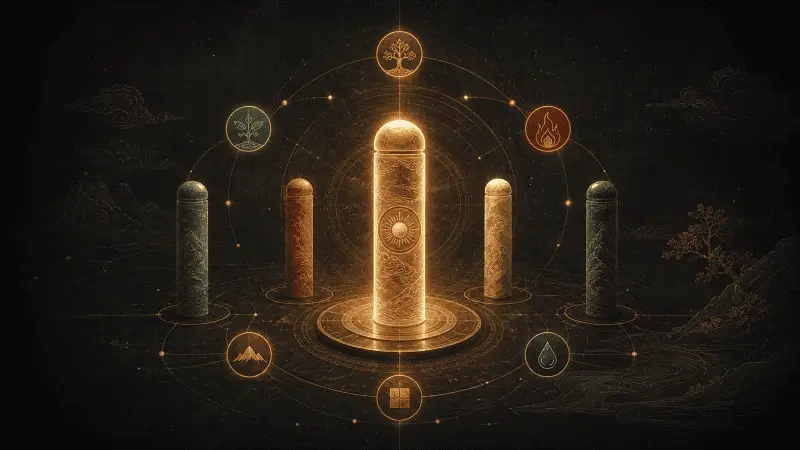
The Day Master is the chart's reference point
The Day Master is the Heavenly Stem of the Day Pillar and the reference point for a BaZi reading. It shows where the "self" sits in the chart, but it is not a standalone personality type. Its meaning depends on the Month Branch, season, Five Elements, Ten Gods, and the rest of the chart.
Where the Day Master appears
Every BaZi chart has Year, Month, Day, and Hour Pillars. Each pillar contains one Heavenly Stem above one Earthly Branch.
Look at the upper character
The Heavenly Stem at the top of the Day Pillar is the Day Master. The branch below it is part of the Day Pillar, but it is not the Day Master.
Read the other symbols from here
The same Wood, Fire, Earth, Metal, or Water can represent a different relationship depending on which Day Master it surrounds.
The Day Master is one of Jia, Yi, Bing, Ding, Wu, Ji, Geng, Xin, Ren, or Gui. The all 10 Day Masters reference compares their Five Elements, polarity, and reading conditions without turning them into personality types.
Why season and the Month Branch matter
The Month Branch supplies the chart's most important seasonal context. A Wood Day Master born in spring sits in a different environment from Wood born in autumn. Spring supports Wood's growing season; autumn brings stronger Metal and a different balance of support, restraint, and structure.
The labels "strong" and "weak" cannot be judged from the Day Master name alone. The Month Branch, visible stems, hidden roots, support, restraint, combinations, and full element flow all matter. A Day Master always sits within that larger environment. The guide to a strong and weak Day Master explains how InnerCipher combines those factors without turning strength into a personality grade.
Five Elements describe what surrounds the self
The Day Master's element offers a starting quality, not a complete personality profile. Wood can suggest growth, Fire expression, Earth containment, Metal refinement, and Water movement, but these teaching images do not override the chart.
Instead of counting elements and declaring one missing, ask what each element does relative to the Day Master:
- Does it support the Day Master?
- Does the Day Master produce or express through it?
- Does it restrain the Day Master?
- Is it something the Day Master controls or manages?
- Is it a peer or same-element force?
The separate guide shows how Five Elements are read in context.
Ten Gods turn those relationships into roles
The Ten Gods are not supernatural beings. They are relationship labels derived from the Day Master, Five Element cycles, and yin-yang polarity. Support becomes Resource, what the Day Master produces becomes Output, what it controls becomes Wealth, what controls it becomes Authority, and the same element becomes Peer.
No element carries one permanent Ten God label; its role changes with the Day Master. The Ten Gods derivation guide shows how the ten names are calculated and why they must remain contextual.
Avoid reducing the Day Master to a type
"I am Yi Wood, so I must be gentle" or "I am Bing Fire, so I must be outgoing" jumps to a conclusion too quickly. Season, support, pressure, output, position, and timing can change how the same Day Master operates.
The BaZi personality analysis guide shows how to combine those layers without turning the Day Master into a type.
The Day Master also cannot guarantee career, relationship, wealth, or future events. It is a coordinate that helps the reader organize the chart. Life-area interpretation only becomes responsible after the surrounding structure is clear.
Is the Day Master the same as a zodiac sign?
No. A zodiac sign is usually a year-animal label. The Day Master is the Heavenly Stem of the Day Pillar and must be read with the Month Branch, Five Elements, Ten Gods, and full Four Pillars chart.
Is a strong Day Master always better?
No. Strength is one condition, not a score. A stronger Day Master can still become rigid or excessive, while a less supported Day Master can function coherently when the chart has useful support and flow.
How can I see my own Day Master?
Use the localized calculator to generate your chart and find your Day Master. The calculation identifies the Day Pillar; this article explains what that reference point means afterward.
Use the Day Master as a coordinate, not a label
Begin with the Day Master, then read it within the season, Five Elements, Ten Gods, and full chart. This keeps the reading from collapsing into a one-line type and makes later interpretation easier to evaluate.
Start with your chart
See these ideas in the context of your own chart
Enter your birth date, time, and place to generate a Free Brief. Review the chart facts and core themes first, then decide whether to unlock the Full Report.
Generate my Free Brief