
BaZi Academy
Five Elements in BaZi: Balance and Missing Elements
The Five Elements are not a checklist. In BaZi, each element depends on its role, season, strength, and relationship to the Day Master.
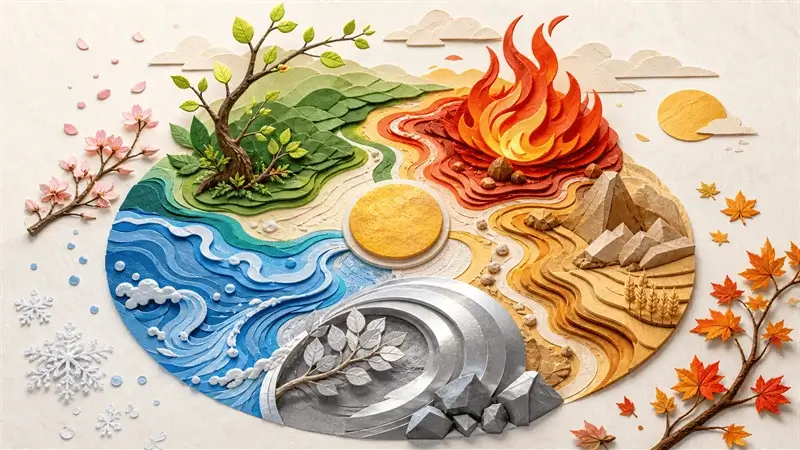
The Five Elements describe relationships
Wood, Fire, Earth, Metal, and Water are the five basic elements used in BaZi. They describe growth, warmth, stability, refinement, movement, support, restraint, and transformation. In a chart, each element is read through what it does in relation to the others.
An element can support the Day Master, drain it, control it, be controlled by it, or stand beside it. The same element can therefore mean different things for different Day Masters. Simple element counts often miss those differences.
The generating and controlling cycles
At the basic level, the Five Elements form two major cycles. In the generating cycle, Wood feeds Fire, Fire creates Earth, Earth produces Metal, Metal generates Water, and Water nourishes Wood. In the controlling cycle, Wood controls Earth, Earth controls Water, Water controls Fire, Fire controls Metal, and Metal controls Wood.
These cycles have a practical use in chart reading. They help explain why one element may support a pattern while another creates pressure or friction.
How support moves
The generating cycle shows how one element can feed another. In a chart, this can describe learning, expression, resource, or momentum depending on the Day Master.
How pressure moves
The controlling cycle shows how one element restrains another. In a chart, this can describe discipline, responsibility, structure, resistance, or stress.
The Day Master changes the meaning
The Day Master sets the chart's reference point. Once it is known, every other element receives a role. For a Wood Day Master, Water may be resource, Fire may be output, Earth may be wealth, Metal may be pressure, and Wood may be peer force. Those roles change for a Fire Day Master.
This is why a Five Elements report should not simply say "you have too much Fire" or "you lack Water." It should ask what Fire and Water mean in relation to the Day Master, the season, and the chart pattern.
Season changes strength
Season changes how much weight an element carries in BaZi. Wood in spring is not the same as Wood in autumn, just as Fire in summer is not the same as Fire in winter. The Month Branch indicates the chart's seasonal environment, which can make an element strong, weak, timely, or out of season.
An element that appears once in the right season may carry more weight than one that appears several times with little support. A report therefore needs to consider placement and season alongside the count. The separate guide to Day Master strength shows how season is combined with visible support, roots, and opposing forces.
Why missing elements can mislead
Many beginner readings say that a missing element must be added through color, objects, habits, or lifestyle. That approach is too mechanical when the missing element is not useful, the chart needs regulation rather than addition, or the element is hidden in branches or timing cycles. The Useful God method explains how InnerCipher tests seasonal needs, Chart Structure, and Day Master strength before classifying an element as useful.
Missing-element language can still be helpful as a question. It may point to a theme that is less visible or less naturally expressed. But it should not become a rigid prescription.
How to use the Five Elements section of a report
When reading a Five Elements section, ask four questions:
- Which elements are visible in the chart?
- Which elements are strong because of season or position?
- What role does each element play for the Day Master?
- Which elements help the chart become more coherent?
These questions move the reading beyond a checklist and into the chart's structure.
For a life-area application, the BaZi personality analysis guide shows how element functions combine with season, Ten Gods, and chart positions.
Is a balanced chart always better?
Not necessarily. Balance in BaZi is not equal quantity. A chart can be coherent without every element appearing evenly.
Should I add my missing element?
Not automatically. First ask whether that element is useful, excessive, hidden, or activated by timing.
What should I read next?
Start with BaZi basics, then read the Day Master guide and Ten Gods guide.
Read relationships, not a missing-element checklist
The Five Elements describe movement and relationship. They clarify the chart's structure when read through the Day Master, season, position, and timing. Reduced to a missing-element checklist, they can mislead instead.
Start with your chart
See these ideas in the context of your own chart
Enter your birth date, time, and place to generate a Free Brief. Review the chart facts and core themes first, then decide whether to unlock the Full Report.
Generate my Free Brief