
BaZi Academy
What Is BaZi? Four Pillars of Destiny Explained in Plain English
BaZi turns birth data into Four Pillars and Eight Characters. A reading then looks at how the stems, branches, yin-yang, and Five Elements relate to the Day Master.
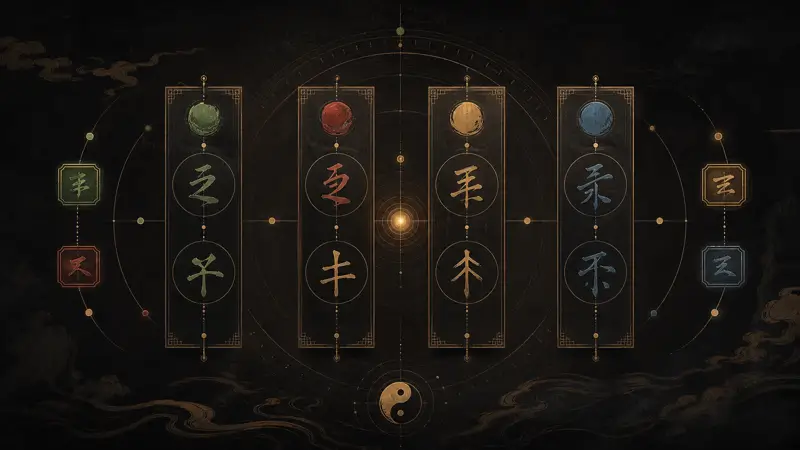
BaZi in one direct definition
BaZi, also called the Four Pillars of Destiny, is a Chinese birth-time system. It converts the year, month, day, and hour of birth into four stem-branch pairs, or eight characters. Readers interpret patterns through the Day Master, Five Elements, and relationships among those characters. BaZi is neither a single zodiac label nor a guarantee of future events.
Why it is called Four Pillars and Eight Characters
The four positions are the Year, Month, Day, and Hour Pillars. Each pillar contains one Heavenly Stem above one Earthly Branch. Four pairs create eight characters, the literal meaning of "BaZi."
The positions give the chart structure, but they are not four independent predictions. The Year Pillar provides a wider background; the Month Pillar carries strong seasonal context; the Day Pillar contains the Day Master; the Hour Pillar depends on the birth-time block and adds another layer of detail.
For a labeled view of the four positions, read how birth data becomes a Four Pillars chart.
How birth data enters the system
BaZi does not simply rename a Western birthday. The chart uses the stem-branch calendar and solar-term boundaries. A careful calculation begins with the birth date, known or unknown birth time, birthplace, timezone, and relevant daylight-saving context.
The BaZi month does not always match a Western or lunar calendar month, because Month Pillar boundaries are tied to solar terms. The Hour Pillar uses two-hour branches, so time and place can matter near a boundary.
These are calculation facts, not interpretation claims. The result is a set of Four Pillars that can then be read.
Heavenly Stems and Earthly Branches
BaZi uses ten Heavenly Stems: Jia, Yi, Bing, Ding, Wu, Ji, Geng, Xin, Ren, and Gui. It also uses twelve Earthly Branches: Zi, Chou, Yin, Mao, Chen, Si, Wu, Wei, Shen, You, Xu, and Hai.
Stems combine one of the Five Elements with yin or yang and form the visible upper character of each pillar. Branches form the lower character and carry layers connected with season, time, zodiac animals, and hidden stems.
The animal sign is therefore only one surface layer. A complete BaZi chart uses all four stems and all four branches, not just the birth-year animal.
Yin-yang and the Five Elements
Yin and yang describe complementary modes rather than good and bad. Yang is often associated with more outward or direct movement, while yin is associated with more inward or subtle movement. Every Heavenly Stem combines one polarity with one element.
The Five Elements are Wood, Fire, Earth, Metal, and Water. In this system they form a symbolic relationship language:
- Wood is associated with growth and expansion.
- Fire is associated with expression and visibility.
- Earth is associated with containment and integration.
- Metal is associated with structure and refinement.
- Water is associated with movement and adaptation.
The generating and controlling cycles describe how those qualities support, produce, restrain, or redirect one another. They are traditional symbolic relationships, not modern scientific claims.
The Day Master gives the chart a point of view
The Day Master is the Heavenly Stem of the Day Pillar, the chart's self-reference point. The same element can play a different role depending on how it relates to that Day Master.
This is where the Ten Gods enter. Despite the name, they are not supernatural beings. They are ten relationship labels derived by comparing the Day Master with the other stems through element and polarity.
The Day Master is still not a standalone personality type. Month Branch, season, Five Elements, roots, combinations, and the rest of the chart shape its meaning. The detailed Day Master guide explains that role without turning it into a finder or type test.
What BaZi can and cannot do
A careful BaZi reading can organize observations about temperament, decision patterns, support, pressure, relationship dynamics, work style, resource handling, and changing timing themes. It can offer a framework for reflection.
It cannot remove choice, model every real-world condition, or guarantee an event. It should not replace medical, legal, financial, or other qualified advice. A more useful question than "What must happen?" is "What pattern or context is worth examining?"
Is BaZi the same as the Chinese zodiac?
No. The zodiac usually focuses on the birth-year animal. BaZi uses Year, Month, Day, and Hour Pillars, with one stem and one branch in each.
Is BaZi based on the lunar calendar?
Not in the simple sense. BaZi uses the stem-branch calendar, and the Year and Month Pillars are strongly tied to solar terms.
Do I need an exact birth time?
Exact time helps determine the Hour Pillar. If it is unknown, the available pillars can still be calculated, but hour-dependent details should remain explicitly uncertain.
Continue with the page that matches your task
The chart-basics guide explains how birth data becomes a Four Pillars chart. If you already have a chart, continue with how to read a BaZi chart step by step. Those pages cover the detailed anatomy and reading sequence, while this introduction stays focused on defining the system.
Start with your chart
See these ideas in the context of your own chart
Enter your birth date, time, and place to generate a Free Brief. Review the chart facts and core themes first, then decide whether to unlock the Full Report.
Generate my Free Brief