
BaZi Guide
How to Read a BaZi Chart Step by Step
A BaZi chart is easier to read in sequence: begin with the Day Master and season, then connect the Five Elements and Ten Gods with life areas and timing.
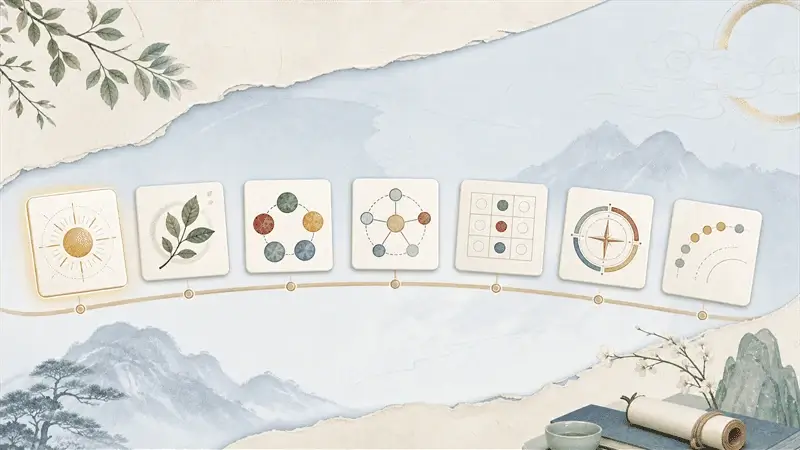
Use one reading sequence
Trying to interpret every symbol at once makes a BaZi chart harder to follow. Use a fixed sequence instead: find the Day Master, check the Month Branch and season, review the Five Elements, derive the Ten Gods, understand the overall structure, and then move into life areas and timing.
Step 1: identify the Day Master
The Day Master is the Heavenly Stem of the Day Pillar and the chart's self-reference point. Every other stem is interpreted by how its element and polarity relate to it. If that foundation is unfamiliar, begin with what the Day Master means.
Do not turn the Day Master into a standalone personality type. Note which stem it is, then keep reading.
Step 2: read the Month Branch and season
The Month Branch shows the seasonal environment. It helps indicate which elements are timely, supported, pressured, or out of season. The same Day Master can operate differently in spring, summer, autumn, or winter. To see how the remaining pillars modify that seasonal baseline, review the current Day Master strength method.
Where the chart is read from
It supplies the reference point for all element and Ten God relationships.
The environment around it
It supplies seasonal context before strength, usefulness, or pattern is judged.
Step 3: read Five Elements as relationships
Review Wood, Fire, Earth, Metal, and Water, but look beyond the counts. Ask which elements support the Day Master, which carry its Output, which it controls, which control it, and which act as peers. Placement, season, roots, and flow matter alongside quantity.
The Five Elements guide explains how Five Elements are read in context.
Step 4: derive the Ten Gods
The Ten Gods translate element and polarity relationships into Peer, Output, Wealth, Authority, and Resource roles. Use the actual Day Master relationship rather than attaching a permanent label to an element. The reference guide shows how the Ten Gods are derived.
Step 5: look at the overall structure
Step back from the individual symbols and look at the chart as a whole. Notice repeated forces, seasonal support, visible and hidden roots, combinations, clashes, production, control, and whether the chart has a clear emphasis or competing pulls. The dedicated guide explains how Chart Structure is determined from the Month Branch, visible stems, and Ten Gods under InnerCipher's method.
Use the combinations and clashes reference to separate a detected relation from transformation conditions and final interpretation.
Do not rank the chart as good or bad. The goal is to understand how its parts work together and which observations are supported by more than one signal.
Step 6: apply the structure to life areas
Once the foundation is clear, apply it to relationships, career, wealth, learning, boundaries, and decision style. These are different uses of the same chart, not separate predictions pasted onto it.
Translate symbols into observable questions: How does this person seek support? What creates pressure? How do they express ability? What kind of exchange or responsibility repeats?
Step 7: add timing last
Luck Pillars and annual influences add movement to the natal chart. Read them after the base structure so that a new element or Ten God has a chart-specific meaning. Treat timing as changing context, not fixed fate. The timing guide explains how Luck Pillars and annual timing work.
Worked example: follow the same seven steps
Assume the chart's Day Master is Yi Wood (乙), the Month Branch is Wu (午), Fire is visibly emphasized, and Water support appears less visible. Work through the sequence without inventing the missing chart data:
- Day Master: Yi Wood supplies the reference point. It is not enough to declare the person gentle, flexible, or artistic.
- Season: Wu represents a summer and Fire context. This changes the environment around Yi Wood and makes heat and Output more relevant questions.
- Five Elements: Visible Fire suggests Output may be active, while less visible Water raises a Resource/support question. Counts alone cannot establish whether either force is useful or excessive.
- Ten Gods: For Yi Wood, Fire is Output, Water is Resource, Earth is Wealth, Metal is Authority/Officer, and Wood is Peer. These roles come from relationship, not from generic element meanings.
- Overall structure: Ask whether Fire has enough support, whether Wood has roots, and how the omitted stems and branches change the flow. Do not assign a pattern grade from the schematic.
- Life areas: Active Output might be explored through expression, production, or communication, while limited visible Resource might raise questions about learning, recovery, or support. These are questions, not personality verdicts.
- Timing: A later Water or Wood layer could change the context of support and capacity; another layer could introduce different pressure. It does not guarantee a promotion, breakup, windfall, or any other event.
The example works because every inference follows the same order and stops when the available data runs out.
What should a beginner read first in a BaZi chart?
Start with the Day Master and Month Branch. They supply the chart's reference point and seasonal environment before element roles or life areas are interpreted.
Can element counts replace the reading sequence?
No. Counts are one clue. Season, placement, roots, relationships, combinations, and the Day Master determine what those counts mean.
Keep the sequence visible
A conclusion should trace back through the Day Master, season, Five Elements, Ten Gods, overall structure, application, and timing. If it skips those layers, return to the chart and check what supports it.
Start with your chart
See these ideas in the context of your own chart
Enter your birth date, time, and place to generate a Free Brief. Review the chart facts and core themes first, then decide whether to unlock the Full Report.
Generate my Free Brief