
BaZi Academy
The 10 Day Masters in BaZi: Meanings in Context
Any of the ten Heavenly Stems can appear as the Day Master. This reference compares their elements and polarities without turning them into fixed personality types.
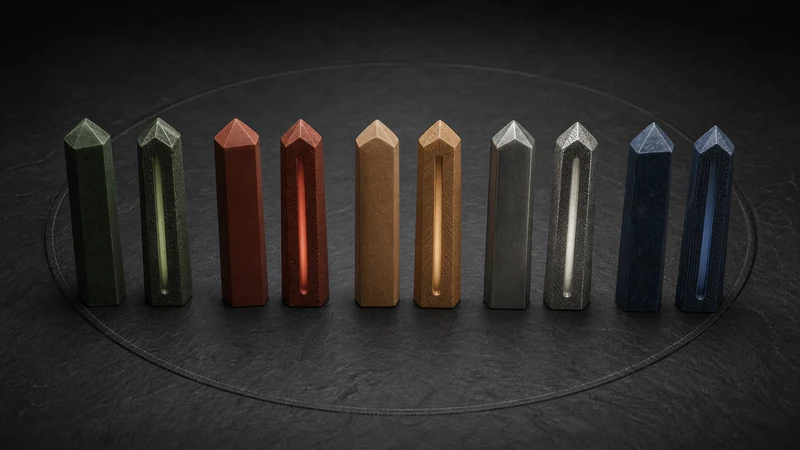
The 10 Day Masters in BaZi are Jia, Yi, Bing, Ding, Wu, Ji, Geng, Xin, Ren, and Gui when one of them appears as the Heavenly Stem of the Day Pillar. Each has a Five Element and a yin or yang polarity. These ten possibilities set the chart's reference point, but they are not ten complete personality types.
The Day Master guide explains where the Day Pillar sits and why its stem becomes the chart's reference point. This article compares all ten stems and shows what must be checked before any image or trait language is used.
The complete 10 Day Masters table
The table follows the Heavenly Stem order and Five Element data used by InnerCipher's current calendar library. "Teaching image" means a traditional analogy that helps a beginner remember the stem. It is not a factual description of everyone with that Day Master.
| Day Master | Element and polarity | Teaching image | What to check next |
|---|---|---|---|
| Jia 甲 | Yang Wood | A trunk or upright growth | Seasonal support, roots, pruning or pressure, and available Output |
| Yi 乙 | Yin Wood | Vines, grasses, or flexible growth | Root network, surrounding structures, season, and whether support is sustained |
| Bing 丙 | Yang Fire | Sunlight or broad heat | Season, fuel, Water pressure, and whether expression has a route |
| Ding 丁 | Yin Fire | A lamp or concentrated flame | Fuel, protection, seasonal temperature, and nearby controlling forces |
| Wu 戊 | Yang Earth | A mountain or broad ground | Moisture, seasonal state, Wood control, and whether Earth is supported or overloaded |
| Ji 己 | Yin Earth | Cultivated soil or workable ground | Moisture, roots, seasonal condition, and what the chart asks Earth to carry |
| Geng 庚 | Yang Metal | Ore, an implement, or unrefined metal | Fire shaping, Earth support, season, and whether Metal has useful work |
| Xin 辛 | Yin Metal | Refined metal or a precise edge | Season, Water expression, Earth support, and pressure from Fire |
| Ren 壬 | Yang Water | A river, current, or open water | Source, channel, season, Earth control, and where movement can go |
| Gui 癸 | Yin Water | Rain, mist, or stored moisture | Metal support, seasonal temperature, roots, and whether Water can circulate |
The images are deliberately incomplete. A river can be frozen, dammed, replenished, or dispersed. Cultivated soil can be dry, saturated, rooted, or unused. Those changes come from the rest of the chart, not from a longer list of adjectives attached to the Day Master.
Five element pairs, each divided by polarity
The ten stems form five same-element pairs. Yin and yang distinguish how the element is represented, while the element relationship stays the same.
Jia and Yi: Yang Wood and Yin Wood
Jia and Yi are both Wood. Water produces them, they produce Fire, they control Earth, and Metal controls them. The polarity changes every Ten Gods pairing around the Day Master.
The tree and vine images can help a beginner remember yang and yin Wood, but neither image proves rigidity, adaptability, ambition, or sociability. A Jia Wood Day Master without roots in autumn differs sharply from rooted Jia Wood in spring. Yi Wood can also be firmly supported or heavily constrained. The chart decides which parts of an analogy remain useful.
Bing and Ding: Yang Fire and Yin Fire
Bing and Ding are both Fire. Wood supports them, they produce Earth, they control Metal, and Water controls them.
Sun and lamp imagery describes scale and polarity, not temperament. A Ding Fire Day Master can receive abundant Wood support or face strong winter Water. Bing Fire can be seasonally strong or lack a stable route for its Output. Questions about fuel, season, and control are more reliable than saying one is outgoing and the other reserved.
Wu and Ji: Yang Earth and Yin Earth
Wu and Ji are Earth. Fire produces them, they produce Metal, they control Water, and Wood controls them.
Mountain and cultivated-soil images are memory aids. They do not prove that Wu is immovable or Ji is nurturing. Earth changes greatly with season and moisture. The surrounding Wood, Fire, Metal, and Water relations determine whether Earth is supported, compacted, drained, or asked to manage too much.
Geng and Xin: Yang Metal and Yin Metal
Geng and Xin are Metal. Earth supports them, they produce Water, they control Wood, and Fire controls them.
Unrefined and refined metal are common teaching images. They do not establish toughness, elegance, bluntness, or perfectionism. A Xin Metal Day Master in a strong autumn Metal environment differs from the same stem under intense Fire. Geng Metal also changes with roots, available Fire, Water expression, and Chart Structure.
Ren and Gui: Yang Water and Yin Water
Ren and Gui are Water. Metal produces them, they produce Wood, they control Fire, and Earth controls them.
River and rain imagery helps distinguish scale, but it does not define emotional style or intelligence. Ren Water can be contained or dispersed. Gui Water can have deep roots and strong Metal support. Season and the wider element network decide how either stem functions.
Why the same Day Master can read differently
After identifying the stem, a reading still needs at least six layers of chart evidence.
Month Branch and season
The Month Branch gives the Day Master its seasonal environment. Wood in spring, Fire in summer, Metal in autumn, and Water in winter start from different conditions than the same elements out of season. Earth also changes across the seasonal branches.
Strength and roots
Visible support, Hidden Stems, root locations, and controlling or draining elements contribute to the Day Master strength assessment. Strong and weak describe support within the chart. They do not rank the person.
Ten Gods
Every other stem receives a Ten Gods role relative to the Day Master. Changing the Day Master changes those roles even when the other stem stays the same. Polarity is especially important because it separates each role family into two.
Chart Structure
Chart Structure organizes the Month Branch, its Hidden Stems, exposed stems, and selected special conditions. Two charts with the same Day Master can receive different structure labels because their month order and visible relationships differ.
Combinations and clashes
Stem and branch relations can connect, pressure, redirect, or interrupt parts of the chart. The Day Master name alone does not contain any of these relations.
Timing
Luck cycles and annual pillars introduce temporary stems and branches. They can change which roles are prominent, but they do not rewrite the natal Day Master or guarantee an event.
Worked comparison: two Gui Water Day Masters
Two non-user calculations use Tianjin, China, at 39.1° N, 117.2° E in the Asia/Shanghai time zone. Both produce a Gui Water Day Master and the same year, day, and hour pillars. Their dates and Month Pillars differ.
| Calculated fact | April 7, 1992 at 16:00 | October 4, 1992 at 16:00 |
|---|---|---|
| True solar time | 15:46 | 16:00 |
| Four Pillars | Ren Shen / Jia Chen / Gui Chou / Geng Shen | Ren Shen / Ji You / Gui Chou / Geng Shen |
| Month Branch | Chen, spring transition | You, autumn |
| Strength | 48, neutral leaning weak | 80, strong |
| Chart Structure | Friend structure | Indirect Resource structure, marked virtual |
| Combined elements | Wood 2, Fire 0, Earth 6, Metal 6, Water 6 | Wood 0, Fire 0, Earth 5, Metal 8, Water 5 |
| Visible Month Stem role | Hurting Officer | Seven Killings |
The Gui Water label is identical, but the seasonal setting, strength result, structure, element distribution, and visible Month Stem role are not. The October chart has stronger Metal support and no Wood in the calculated distribution. The April chart has visible Output through Jia Wood and a much lower strength score.
This comparison does not create two Gui Water personality types. It shows why a Day Master image cannot finish the reading. A chart-wide BaZi personality analysis may use the Day Master, but it must also account for the evidence around it.
How to find your Day Master
In a Four Pillars chart, locate the Day Pillar and read its upper character. That Heavenly Stem is the Day Master. The lower character is the Day Branch, which is a different part of the chart.
You can use the InnerCipher BaZi calculator to generate the Four Pillars from birth date, time, location, time zone, and true solar time. This article does not calculate a personal result or infer one from a birth year alone.
Common mistakes
Treating the ten stems as ten fixed personality profiles
The table gives element, polarity, and teaching imagery. Personality claims need the whole chart and real-world comparison.
Assuming Yang means extroverted and Yin means introverted
Yin and yang classify polarity within the stem system. They are not psychological test scores.
Ranking one Day Master above another
No stem is inherently more capable, successful, healthy, wealthy, or suitable for relationships. The ten stems are reference points, not grades.
Reading a Day Master without season or roots
The same stem can be supported, unrooted, controlled, drained, or balanced differently. Month order and Hidden Stems belong in the reading.
Where the Day Master appears in an InnerCipher report
The Free Brief includes basic information, zodiac interpretation, Five Elements analysis, and core Chart Structure. Report generation requires Google sign-in. The optional one-time Full Report adds Ten Gods analysis, relationship analysis, wealth and career, and annual analysis.
Each module uses the same calculated Day Master as a reference point. None can turn the stem by itself into a fixed personality, career, marriage, wealth, or future prediction.
Are there exactly 10 Day Masters in BaZi?
Yes. Any of the ten Heavenly Stems can occupy the Day Stem position: Jia, Yi, Bing, Ding, Wu, Ji, Geng, Xin, Ren, or Gui.
Is one Day Master better than another?
No. Each identifies an element and polarity. Its condition depends on season, roots, strength, surrounding roles, and the rest of the chart.
Can the Day Master alone describe my personality?
No. It supplies the chart's reference point. A personality reading still needs the Month Branch, Five Elements, Ten Gods, positions, roots, interactions, and lived evidence.
Start with your chart
See these ideas in the context of your own chart
Enter your birth date, time, and place to generate a Free Brief. Review the chart facts and core themes first, then decide whether to unlock the Full Report.
Generate my Free Brief