
BaZi Academy
BaZi Combinations and Clashes Explained
Combinations and clashes modify relationships inside a BaZi chart. Their presence, possible transformation, and practical meaning are separate questions.
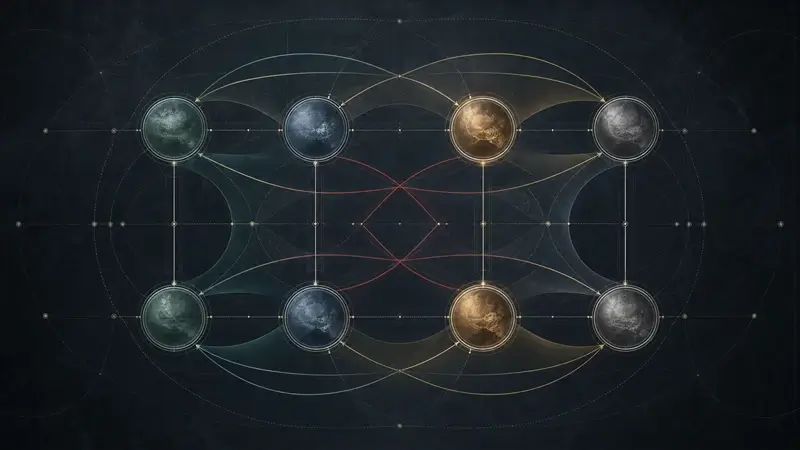
BaZi combinations and clashes are relationships among Heavenly Stems or Earthly Branches. They modify how chart positions connect, support, restrain, or pull against one another. A combination is not automatically good, and a clash is not automatically bad. Finding a relation, meeting transformation conditions, and interpreting its effect are three separate tasks.
Heavenly Stems and Earthly Branches use different relation sets
The four Heavenly Stems are the visible upper characters of the pillars. The four Earthly Branches sit below them and also contain hidden stems. Stem combinations compare visible stem positions. Branch relations include Six Harmonies, Three Harmonies, Six Clashes, Six Harms, Three Punishments, and Six Breaks.
These systems should not be collapsed into one generic idea of "compatibility." A stem pair and a branch clash can appear in the same chart. Several branch relations can also involve the same positions. Each relation stays in the chart until context shows how much weight it deserves.
The five Heavenly Stem combinations
The reference pairs are fixed, but a pair does not establish transformation.
| Stem pair | Reference result | Month Branches accepted by the current transformation check |
|---|---|---|
| Jia 甲 + Ji 己 | Earth | Chen 辰, Xu 戌, Chou 丑, Wei 未 |
| Yi 乙 + Geng 庚 | Metal | Shen 申, You 酉 |
| Bing 丙 + Xin 辛 | Water | Hai 亥, Zi 子 |
| Ding 丁 + Ren 壬 | Wood | Yin 寅, Mao 卯 |
| Wu 戊 + Gui 癸 | Fire | Si 巳, Wu 午 |
Two stems can form one of the five reference pairs without changing the chart into the resulting element. The current engine records a transformation pattern only when its narrower conditions are met.
Earthly Branch combinations
Six Harmonies
| Pair | Pair | Pair |
|---|---|---|
| Zi 子 + Chou 丑 | Yin 寅 + Hai 亥 | Mao 卯 + Xu 戌 |
| Chen 辰 + You 酉 | Si 巳 + Shen 申 | Wu 午 + Wei 未 |
The current branch-relation engine records these pairs as Six Harmonies when both branches appear in the positions being compared. A recorded pair is a connection. The engine does not use that record alone to declare elemental transformation or a favorable outcome.
Three Harmonies
| Complete three-branch set | Reference formation |
|---|---|
| Shen 申 + Zi 子 + Chen 辰 | Water |
| Yin 寅 + Wu 午 + Xu 戌 | Fire |
| Hai 亥 + Mao 卯 + Wei 未 | Wood |
| Si 巳 + You 酉 + Chou 丑 | Metal |
Earthly Branch clashes, harms, punishments, and breaks
Six Clashes
| Pair | Pair | Pair |
|---|---|---|
| Zi 子 + Wu 午 | Chou 丑 + Wei 未 | Yin 寅 + Shen 申 |
| Mao 卯 + You 酉 | Chen 辰 + Xu 戌 | Si 巳 + Hai 亥 |
Six Harms
| Pair | Pair | Pair |
|---|---|---|
| Zi 子 + Wei 未 | Chou 丑 + Wu 午 | Yin 寅 + Si 巳 |
| Mao 卯 + Chen 辰 | Shen 申 + Hai 亥 | You 酉 + Xu 戌 |
Three Punishments in the current detector
| Type | Branches | Current detector behavior |
|---|---|---|
| Ungrateful Punishment | Yin 寅, Si 巳, Shen 申 | Records each distinct pair found within the set |
| Bullying Punishment | Chou 丑, Xu 戌, Wei 未 | Records each distinct pair found within the set |
| Uncivil Punishment | Zi 子 + Mao 卯 | Records the pair when both are present |
| Self-Punishment | Chen 辰, Wu 午, You 酉, Hai 亥 | Requires the same listed branch to appear at least twice |
This table describes the current code's detection behavior. It is not a claim that every tradition defines partial punishment sets in the same way.
Six Breaks
| Pair | Pair | Pair |
|---|---|---|
| Zi 子 + You 酉 | Yin 寅 + Hai 亥 | Chen 辰 + Chou 丑 |
| Wu 午 + Mao 卯 | Shen 申 + Si 巳 | Xu 戌 + Wei 未 |
Presence and transformation are different questions
For each relation, keep the claims in order:
- Check presence: are the required stems or branches in the compared positions?
- Check the implementation: does the current engine have a specific transformation or timing rule for this relation?
- Add context: what are the season, Five Element roles, roots, positions, and other relations?
- Interpret last: what limited effect does the complete chart support?
Skipping from the first question to the fourth turns a lookup table into a prediction. The tables establish relationships. They do not settle what those relationships mean for a person.
What gives a relation more or less weight
Season and roots
The Month Branch sets the seasonal environment. A relation involving supported elements may carry different weight from the same pair when both elements are weak or unrooted. A reference result in a combination table does not override the chart's actual support.
Position and repetition
Relations connect particular pillars. A year-month relation is not the same structural placement as a day-hour relation. Repeated branches may produce several records, and one pair can qualify for more than one relation type. Position helps organize the evidence, but it does not assign a guaranteed life event.
Other relations
A Six Harmony can coexist with a Clash, Harm, Punishment, or Break elsewhere in the chart. In the current detector, Si and Shen are especially clear: the pair qualifies as a Six Harmony, an Ungrateful Punishment pair, and a Six Break. The code keeps all three records rather than choosing a single story.
Natal chart and timing
Natal relations describe the baseline among the four pillars. Timing adds a Luck Pillar or annual branch and checks how it relates to the natal structure. The BaZi forecast guide explains why the natal chart comes first. A timing relation can activate an existing theme, but it does not guarantee the event that popular interpretations attach to that theme.
Worked example 1: one combination among several relations
The branch facts are:
- Year Branch Zi and Day Branch Chou form a Six Harmony.
- Year Branch Zi clashes with both Wu branches, so the engine records two Zi-Wu Six Clashes.
- Each Wu forms a Six Harm with Chou, producing two Harm records.
- Wu appears twice, so the engine also records Wu Self-Punishment.
The Zi-Chou combination is present, but it does not erase the other records. The Ji Earth Day Master is scored 68 and labeled strong, with a Jian Lu pattern. None of this turns the combination into a promise of marriage or wealth, or the clashes into a forecast of disaster. The overlapping relations must remain visible before interpretation begins.
Worked example 2: a clash with repeated branches
The Year Branch Zi and Month Branch Wu form a Six Clash. Chen repeats in the Day and Hour Branches, so the engine also records Chen Self-Punishment. The Geng Metal Day Master is scored 17 and labeled weak.
The output records two different relations in specific positions. It does not prove separation, an accident, or a fixed personality problem. The next questions concern how Water, Fire, Earth, and Metal function in this chart, whether the repeated Chen branches provide roots or add another structural emphasis, and what a later timing layer actually activates.
Common myths about combinations and clashes
- A combination does not automatically mean marriage, reconciliation, wealth, or good fortune.
- A clash does not automatically mean disaster, illness, separation, or a breakup.
- A reference element beside a stem combination does not prove transformation.
- One relation does not cancel every other relation in the chart.
- A timing trigger does not guarantee that a named event will happen that year.
Are BaZi combinations always good?
No. A combination establishes a connection. Its effect depends on the elements involved, season, roots, positions, other relations, and whether any implemented transformation condition is met.
Does a BaZi clash mean a breakup?
No. A clash identifies a branch relation, not a relationship outcome. One chart also cannot model another person's choices or the full circumstances of a partnership.
Does every Three Harmony transform into an element?
No. The full three-branch set must first be present in the relevant method. InnerCipher currently evaluates it in the timing layer, and even a completed set is not treated as an automatic transformation or stand-alone verdict.
Keep the relation map intact
Record every supported stem and branch relation first. Then check whether the current method has a transformation rule, add season, roots, positions, and overlapping relations, and bring in timing last. The tables tell you what is present. The full chart tells you how much weight it carries.
Start with your chart
See these ideas in the context of your own chart
Enter your birth date, time, and place to generate a Free Brief. Review the chart facts and core themes first, then decide whether to unlock the Full Report.
Generate my Free Brief