
BaZi Guide
Why So Many BaZi Apps Give You a Chart, Not a Reading
A BaZi chart is raw material, not a full reading. Turning it into one requires correct calculation, a consistent rule framework, and clear language.
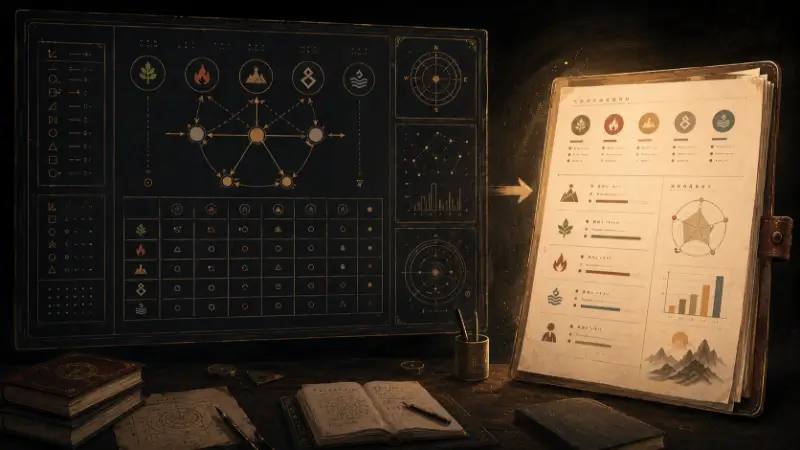
Many BaZi apps calculate a chart but stop before they provide a reading. They show the Four Pillars, Five Elements, Ten Gods, and timing labels without explaining which facts matter, how the pieces relate, or why a conclusion follows from them.
The usual flow is familiar: you enter a birth date, time, and location, and a few seconds later the screen fills with Chinese characters, grids, elemental symbols, and unfamiliar labels.
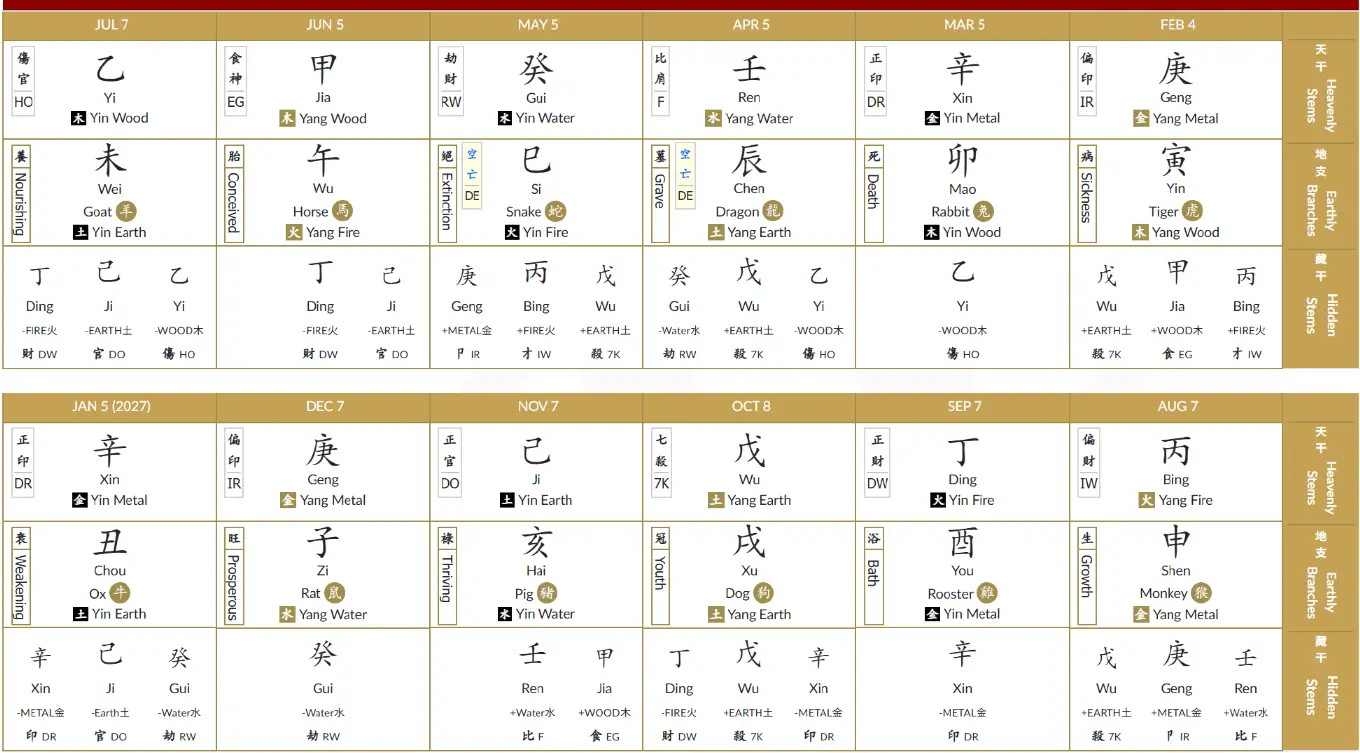
The problem is not that BaZi is too difficult for the reader. It is that the product has not explained where to start, what a Day Master is, why the Ten Gods are relationship labels, or how stems, branches, combinations, and Luck Pillars become an interpretation.
It handed you a chart. It never gave you a reading.
The chart is raw material, not the final product
BaZi, or the Four Pillars of Destiny, takes your birth year, month, day, and hour and converts each into a pair of Heavenly Stems and Earthly Branches. Four pillars produce eight characters, which is where the name "BaZi" (eight characters) comes from.
From there, a full chart might also show the Five Elements, the Ten Gods, Hidden Stems, chart structure, Luck Pillars, and annual cycles.
If you've studied the system, all of that is just the starting point for an interpretation. If you haven't, it's a symbolic language with no translation attached.
At a product level, a BaZi chart isn't too different from a Western natal chart. Both take your birth information and turn it into a structured symbolic map that still needs to be interpreted. The systems have almost nothing in common, but the user's problem is the same either way.
A chart is not an answer.
If the symbols themselves are unfamiliar, the BaZi chart basics guide explains the raw structure before you move into interpretation.
It only becomes useful once someone explains how the pieces relate to each other, why they point to a particular conclusion, and what that conclusion actually means for your personality, relationships, work, or timing in life.
Why do so many products stop at the chart?
There's no shortage of free BaZi calculators online. Plenty of them can spit out your Four Pillars, Ten Gods, elemental distribution, Hidden Stems, and Luck Pillars in a matter of seconds.
But the moment you ask what any of it actually means, you're usually pointed toward a paid one-on-one consultation.
This is not an argument against practitioners charging for their time. A good consultant has to read the chart, understand what the client wants to explore, and translate a complicated system into language that fits a real person's context. That work has real value.
The problem is when the raw chart itself gets marketed as a "reading."
It can look impressive and be packed with information. But if the person staring at it cannot understand or use any of it, the actual job has not been done yet.
You got the chart for free. The meaning stayed locked behind a separate, paid service.
In practice, the chart turns into a lead-generation tool, and the interpretation becomes the actual product being sold.
The path from chart to interpretation can be systematized
The InnerCipher team has spent around five years studying BaZi while also doing product work that required complex processes to be made explicit. That combination led to a practical conclusion: a serious reading takes a lot of work, but it is not an indescribable act of intuition. Its stages and assumptions can be defined.
A complete reading involves several distinct jobs.
First, the birth data has to be normalized for location, time zone, daylight saving time, and solar-term boundaries. Then the system calculates the Four Pillars, Hidden Stems, Ten Gods, Five Element relationships, and Luck Pillars.
The harder part comes next. The system has to work out the chart's structure, identify which rules apply and which take priority, handle combinations and exceptions, and turn the result into language an ordinary reader can follow.
This is not a simple lookup table, though much of the work can still be expressed as rules.
Classical texts like Yuan Hai Zi Ping, Di Tian Sui, Qiong Tong Bao Jian, Shen Feng Tong Kao, and Zi Ping Zhen Quan discuss seasonal strength, the Day Master, chart structure, the Ten Gods, elemental relationships, and timing cycles in detail.
Practitioners don't agree on everything, of course. There's no single version of BaZi that every school signs off on without argument. But that doesn't stop a product from picking a clear framework, being upfront about what it uses, and then applying it consistently instead of picking and choosing.
The hard, unglamorous work is pulling rules from old texts and practitioner knowledge, defining exactly when each rule applies, working out how the rules interact, and resolving cases where several point in different directions.
A chart calculator is much easier to build than an interpretation system you can rely on.
AI made reports easier to read but created another problem
Once generative AI went mainstream, a new type of BaZi product showed up.
Instead of stopping at the chart, these tools just ask a large language model to write out the entire reading.
On paper, that sounds like a real improvement because you get sentences instead of a table nobody can read. But fluent language is not evidence that the interpretation underneath it is correct.
Large language models are very good at producing text that sounds natural and plausible. What they're actually doing, though, is predicting what word is likely to come next. They're not running a deterministic BaZi analysis in the background.
You can feed a model rule documents, classical texts, and worked examples. You can even set up RAG so it retrieves the relevant material before answering. That works well for many knowledge questions. Ask what the Four Pillars are, and it can find the right explanation and rephrase it in plain English.
Interpreting a chart is a different kind of task altogether.
The system needs to establish the chart facts, identify every rule that applies, understand each rule's conditions and priority, work through conflicts and exceptions, and produce a structured set of findings. Only then should it start writing.
Stuffing dozens of rules into a prompt doesn't guarantee the model will actually apply all of them. It might skip something, blend in a different interpretation it picked up from training data, or tack on a conclusion simply because it sounds right in context.
AI can have a useful role in a BaZi product, but a chatbot is not a rules engine.
When one model is expected to calculate the chart, pick the rules, interpret them, and write the report without a separate calculation layer or verification step, consistent results are very hard to guarantee.
Where LLM-only readings tend to fail
The first problem is fact drift. One version of a reading might treat the Day Master as relatively strong. Ask basically the same question a slightly different way, and the next version might quietly flip it to weak. One section calls an element supportive; another calls it harmful without explaining why. Each paragraph can sound reasonable in isolation, yet the conclusions cannot all be true at the same time within the same framework.
The second problem is shallow coverage. The more rules a model tries to apply, the more chances it has to get one wrong. The safest way to reduce visible errors is simply to analyze less. That is how a BaZi reading gets reduced to a handful of personality traits based on the Day Master's element, with barely a mention of season, structure, Ten God combinations, Luck Pillars, or annual changes. The output may look safer, but the system has also been reduced to an elemental personality quiz.
Then there's the vague language:
"You are independent, but you also value support from others."
"You may face challenges in your career, but those challenges can help you grow."
"You need to find a balance between logic and emotion."
Statements like these are hard to argue with, because almost anyone can see themselves in them. That's also exactly why they tell you so little.
The bigger issue, though, is that the source of the conclusion disappears entirely. When a report says you are suited to a particular career, tend to attract a certain kind of partner, or are headed for a major change in a specific period, where did that come from? Which chart fact triggered it? Which rule supports it? Or did the sentence simply sound right while the model was generating the paragraph?
That is what we mean by AI slop.
The problem was never that AI wrote the sentence. The problem is that AI was allowed to invent a finding that should have come from the underlying system in the first place.
AI can write the sentences. It shouldn't be inventing the reading.
What a serious digital BaZi report should do
First, the chart calculation has to be correct, full stop. Birthplace, time zone, daylight saving time, solar-term boundaries, and birth hour all affect the underlying data. No amount of good writing can fix a chart that was wrong to begin with.
The True Solar Time guide explains how InnerCipher currently handles location and time, including the limits of the implementation.
Second, the product needs a defined interpretive framework. It does not need universal agreement among practitioners, but it should apply the same rules consistently instead of reaching for whichever explanation feels convenient in a given generation.
The same inputs and the same rules should always produce the same underlying findings. The wording can change from one version to the next. The facts shouldn't.
Third, the report needs to be willing to state its conclusions. That does not mean claiming someone has only one possible future. It means stating a conclusion when the chosen rules support it, rather than hiding a thin analysis behind vague, feel-good language. If an unknown birth time affects part of the reading, the user should be told exactly what becomes less certain.
A serious report also shouldn't strip out every difficult part of BaZi just to play it safe. If what's left is a short list of broad personality traits, the system has thrown away most of its value along with the risk.
Most important of all: calculation, interpretation, and writing need to stay separate jobs. Birth data produces chart facts. Rules produce interpretive findings. The language layer just makes those findings readable. Once you separate those layers, the writing model can no longer quietly rewrite the foundation of the report out from under you.
Why the team built InnerCipher
InnerCipher is the team's answer to these problems.
We did not want to build one more calculator that produces a complicated chart and leaves the user to interpret it alone. We also did not want to put a stack of BaZi books into a prompt and hope the model applied them consistently. So we took the harder route.
The team started with a defined interpretive framework. InnerCipher draws on traditional sources including Yuan Hai Zi Ping, Di Tian Sui, Qiong Tong Bao Jian, Shen Feng Tong Kao, and Zi Ping Zhen Quan. We also spoke with practicing BaZi consultants to understand how written principles are combined and prioritized in real readings. We do not claim to have found the one true school of BaZi. The goal is narrower: build a framework grounded in recognizable sources, internally coherent, and structured enough to implement in software.
From there, the next step was turning those rules into code, not into a prompt.
InnerCipher first processes birthplace, time zone, daylight saving time, and solar-term boundaries. Then it calculates the Four Pillars and derives the Five Element, Ten God, chart-structure, Luck Pillar, and annual-cycle data that follow from them. A proprietary Divination Engine matches those structured facts against the applicable rules and produces a set of structured findings.
None of that is improvised by a language model. As long as the inputs and rules stay the same, the underlying facts and conclusions stay the same too. Rephrasing a question, or changing how a paragraph is worded, shouldn't be able to turn one chart into a contradictory reading.
InnerCipher does use AI. In parts of the report, AI receives read-only chart context and defined writing tasks, then turns those inputs into smoother, more natural language. It cannot overwrite the stored chart facts. Its output is structurally validated, but natural-language errors are still possible; the public Methodology explains that boundary in more detail.
Put simply:
The rule engine decides what the report says. AI helps say it clearly.
The full InnerCipher report currently runs eight major modules, covering zodiac and Na Yin context, Five Element structure, chart patterns, Ten Gods and personality, relationships, career and wealth, and annual timing across the next decade. It is designed to be read section by section and revisited over time, rather than used as a list of personality tags or a one-page chatbot reply.
InnerCipher is still a work in progress
The team is confident in the work behind the rules and calculation process, but the product has not solved every problem yet.
The team's BaZi study has mainly used Chinese-language sources, so the system is understood most naturally in its original cultural context. We are still learning how Western readers prefer this material to be explained and organized. Some wording may not feel completely natural yet, and some sections may feel more serious, slower, or longer than readers used to short-form content expect.
InnerCipher is also less immediately playful than products built around quick predictions, chat, or one-line results designed for sharing. That is a real product tradeoff, and we will keep working on it.
We may add lighter features later, but they should not replace the core report. The product is not trying to become a fortune-cookie generator. The value we see in BaZi is a structured way to examine recurring patterns: how someone handles pressure, seeks support, approaches work, forms relationships, and moves through different periods. For that purpose, a report built on explicit rules is worth more than a clever sentence that happens to feel accurate.
Before paying for an online BaZi reading, it is worth asking a few questions:
Is the chart calculated by deterministic software?
What determines the conclusions: a defined rule system or a chatbot?
Will the same birth information produce the same underlying findings every time?
Does the system tell you what becomes less certain when the birth time is unknown or the input is incomplete?
Can the AI add, remove, or alter interpretive conclusions on its own?
Those questions matter a lot more than how many ancient symbols show up on the page, or how advanced a product claims its "AI Master" to be.
InnerCipher is still evolving, but it started from one simple idea:
A chart is not a reading, and fluent language is not proof that the interpretation behind it is reliable.
A useful product has to do the hard work in between: calculate the chart correctly, apply a coherent set of rules, and explain the result in plain language.
That is why the team built InnerCipher.
You can start with a free brief and see what your chart looks like once it is translated into a readable report, without booking a private consultation or relying on a chatbot to improvise the conclusions.
Start with your chart
See these ideas in the context of your own chart
Enter your birth date, time, and place to generate a Free Brief. Review the chart facts and core themes first, then decide whether to unlock the Full Report.
Generate my Free Brief